Chapter guide
Dave the Diver Chapters: How Many Are There?
For a spoiler-light planning answer, count seven main story chapters in the base game. Use the checklist below to pace upgrades, boss preparation, restaurant supply, and the separate DLC content without turning every side quest into another chapter.
- Core querydave the diver chapters
- Quick answer7 main chapters
- ScopeBase-game story
- Page typeProgression guide
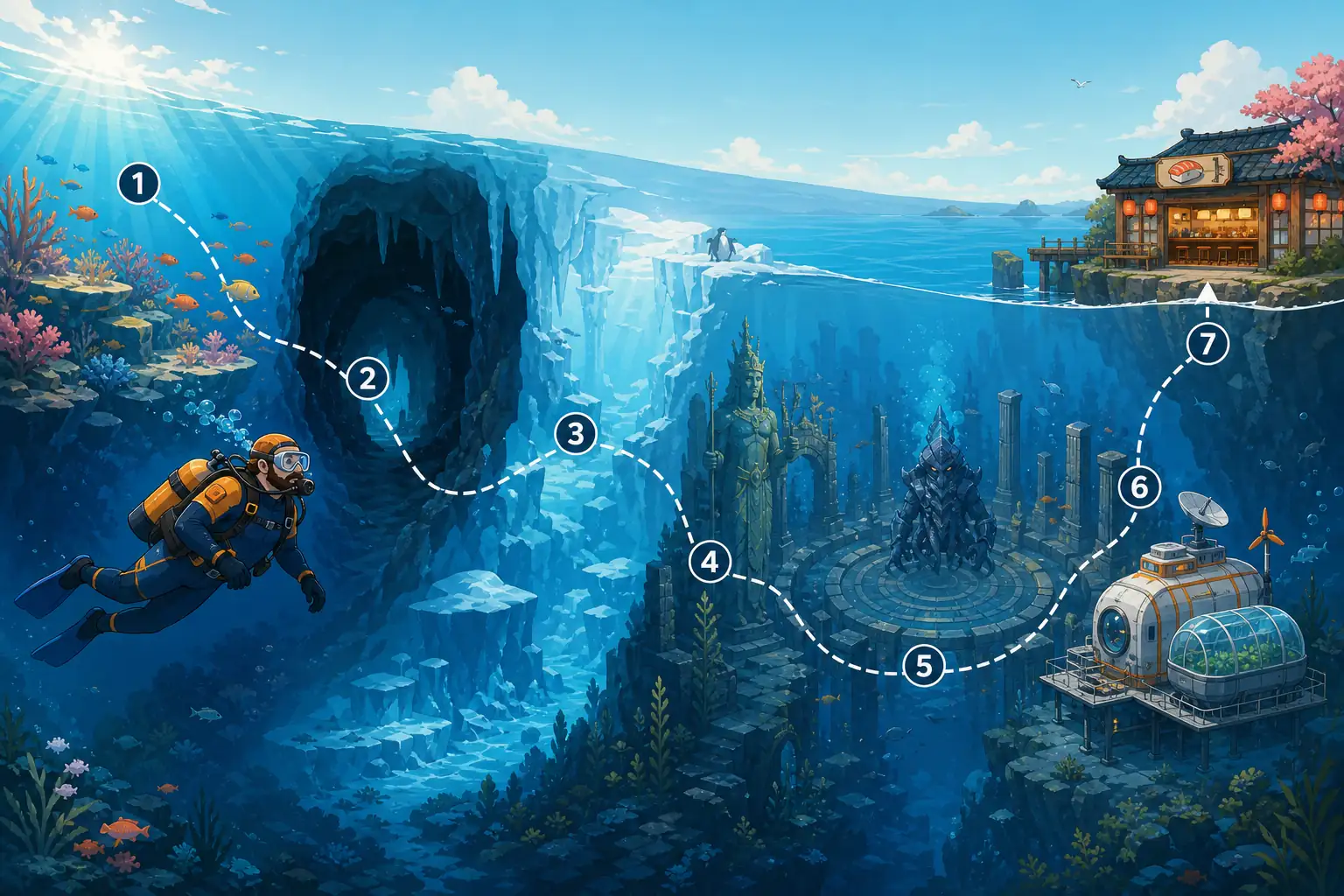
Quick answer
How many chapters are in Dave the Diver?
The practical answer is seven main story chapters for the base game. That is the cleanest way to plan a normal first playthrough, but it is not a promise that every player will see the same number of named sections in the same order. Some references separate a prologue or epilogue, while others group those missions into the nearest chapter.
The important distinction is between the main story and everything around it. Bancho Sushi upgrades, staff training, fish records, collection goals, side quests, achievements, and DLC can continue after the main chapter route. Do not add those activities to the chapter count just because they extend the save.
This page uses chapter numbers as a planning tool rather than pretending that every mission title is an official chapter label. Read each row as a checkpoint: what the game is asking you to learn, which upgrades reduce friction, and what to confirm before pushing the next story objective.
Chapter checklist
Seven main story checkpoints
These are practical guide labels, not a replacement for the mission text shown in your save. Use them to decide what to upgrade before the next story push.| Chapter | Main focus | Prepare before pushing | Checkpoint after |
|---|---|---|---|
| Chapter 1Learn the loop | Build the dive-by-day, sushi-by-night routine and learn how oxygen, cargo, weapons, and menu choices connect. | Keep one reliable weapon, improve survival before chasing rare materials, and avoid spending every fish on experiments. | You can finish a normal dive, serve a manageable menu, and understand which upgrade is blocking progress. |
| Chapter 2Stabilize growth | Turn early discoveries into repeatable money, ingredients, staff coverage, and a less fragile diving route. | Raise the upgrades that protect oxygen and carrying capacity, then keep enough common fish for the next dinner service. | Your restaurant can fund the next dive even when a story mission takes an extra attempt. |
| Chapter 3Go deeper | Deeper zones and tougher encounters make loadout choice more important than simply carrying the highest damage number. | Check range, ammunition, suit strength, and return options. Bring a weapon that solves the target you expect, not only a weapon with a high tier label. | You know when to leave with the cargo you have instead of losing the whole dive to one greedy detour. |
| Chapter 4Balance systems | Story work, restaurant throughput, staff training, and resource farming start competing for the same time and materials. | Use the fish farm and menu planning to reduce repeat trips. Link weapon decisions to the boss or creature that is actually slowing you down. | You can name the next bottleneck: oxygen, cargo, damage, ingredients, staff speed, or a missing unlock. |
| Chapter 5Respect boss gates | Major encounters test whether your build is stable rather than whether you memorized one perfect attack sequence. | Review the boss page, upgrade the weapon that matches the arena, and leave room for movement instead of filling every slot with optional loot. | A failed attempt tells you what to change, rather than forcing a complete rebuild of the save. |
| Chapter 6Finish the route | Late story progress is easier when you preserve a reliable daily loop and stop treating every side activity as urgent. | Keep a reserve of useful materials, make sure the restaurant can pay for retries, and check any outstanding objective text before diving. | You can choose between story progress, collection, or money-making without losing track of the main route. |
| Chapter 7Main-story finish | The final stretch is a completion checkpoint, not the end of every system in the game. | Carry the safest suitable loadout, bring enough supplies for the encounter, and do not confuse a cleared story with 100% completion. | After the main route, move deliberately into achievements, rare fish, recipe work, refights, or DLC preparation. |
Chapter count is presented as a spoiler-light base-game planning convention. Prologue, epilogue, optional missions, and DLC may be grouped differently by individual guides.

Progression rhythm
A chapter is a checkpoint, not a timer
Searchers asking about time per chapter usually want to know when to stop rushing and prepare the rest of the save.There is no fixed number of minutes for a Dave the Diver chapter. The game deliberately mixes story missions with dives, restaurant service, staff development, weapon crafting, events, and optional collection. A player who follows only the next objective can reach the same chapter with a weaker economy than a player who spends one or two in-game days stabilizing the loop.
Use the chapter table as a decision filter. If a new area is dangerous because oxygen is the problem, solve oxygen before buying a damage upgrade. If a boss is consuming attempts, use the weapon and arena guidance instead of endlessly farming unrelated fish. If the restaurant cannot pay for a retry, improve supply and staff flow before treating the story as an emergency.
This approach also keeps the guide separate from the dedicated playtime page. The playtime question asks how long the whole game takes; the chapter question asks what kind of preparation makes the next story step comfortable. Link the two, but do not merge their intents.
Before a story mission
Read the objective once, inspect the expected depth or arena, and choose one primary weapon goal. A simple loadout you understand is safer than a complicated one you cannot upgrade.
Between chapters
Use one dive to refill the ingredient or material that is repeatedly limiting the restaurant. Keep a small reserve so the next story mission does not empty the whole stock.
When a boss blocks progress
Change one variable at a time: weapon range, ammunition, suit strength, oxygen, or movement space. This makes a failed attempt useful and prevents random overfarming.
When the table says Chapter 5
Treat the chapter number as a preparation reminder, not a mandatory speedrun target. This is where boss, weapon, and restaurant pages should work together.
After Chapter 7
Move into 100% goals, achievements, rare fish, recipes, staff training, refights, and DLC only after deciding which completion target you actually want.
Scope check
Chapters, DLC, and 100% are different questions
A chapter checklist should not become a second DLC guide. The base-game count is useful for story pacing, while free or paid content can add missions, events, characters, or systems that sit outside the original chapter route. Check the relevant DLC page when the question is access, ownership, release timing, or a post-story content gate.
The same boundary applies to completion. Achievements and rare collection tasks can continue long after the main story is cleared, so an 80-hour completionist save does not mean the game has 80 chapters. It means the player chose a larger goal around the chapter route.
When a guide says “Chapter 5” or “after the main story,” read it as a progression marker. Always verify the exact mission text in your own save if an update, platform version, or DLC pack changes the surrounding context.

Use the seven-chapter count
This page owns the main-story planning question and the spoiler-light chapter checklist.
Check access separately
DLC timing and unlock conditions belong in the DLC guide, not in the base-game count.
Do not call it extra chapters
Achievements, records, recipes, and rare fish extend the save without changing the main chapter number.
Read your mission text
If a patch or platform edition changes wording, use the in-game objective as the final local source.
Mistakes to avoid
Do not let the chapter number make the loop brittle
The most common mistake is treating the next chapter as a race. Dave the Diver rewards a stable loop: safe dives create fish and materials, the restaurant turns them into money, and money funds the next round of upgrades. Skipping that loop can make a normal story gate feel like a difficulty spike.
Another mistake is using one page for every question. The chapter checklist can tell you when to prepare; it cannot replace a boss matchup table, a weapon comparison, or a fish-location lookup. Use the linked specialist pages so each search intent stays clear and the answer remains easier to scan.
Finally, do not confuse a guide convention with an official UI counter. The seven-chapter answer is useful and consistent for planning, but prologue, epilogue, optional missions, and DLC can be grouped differently. State the scope instead of presenting a community count as a universal game setting.

Official reference
Use the official Steam page for game facts
This is an independent fan guide. Store descriptions, platform availability, update context, and official media should be checked against the current Steam listing rather than treated as permanent facts from a third-party guide.
- Official app
- Steam app 1868140
- Developer / publisher
- MINTROCKET
- Guide scope
- Base-game chapter planning
- Media status
- Official Steam image
FAQ
Dave the Diver Chapters FAQ
Sources and scope
What this page treats as evidence
The chapter number is presented as a practical fan-guide convention, while official platform facts and media are separated from community mission references.
- Official Steam listing for DAVE THE DIVEROfficial store, platform, developer, and publisher reference.
- DAVE THE DIVER community mission referenceCommunity reference used for mission/chapter context; it is not an official MINTROCKET source.
Related guides
Use the chapter checklist with the right specialist guide
The chapter page owns story scope and pacing. Follow the focused guides when you need a boss matchup, weapon choice, fish lookup, farm supply, or whole-game time estimate.